
The Part of a Painting Nobody Sees: Erasing and Starting Again
A finished painting rarely reveals the corrections, doubts and fresh starts behind it. Sometimes, erasing and beginning again is simply part of getting closer to what the artist wants to achieve.
INFORMATIVE
Pramod Sharma
7/14/20262 min read
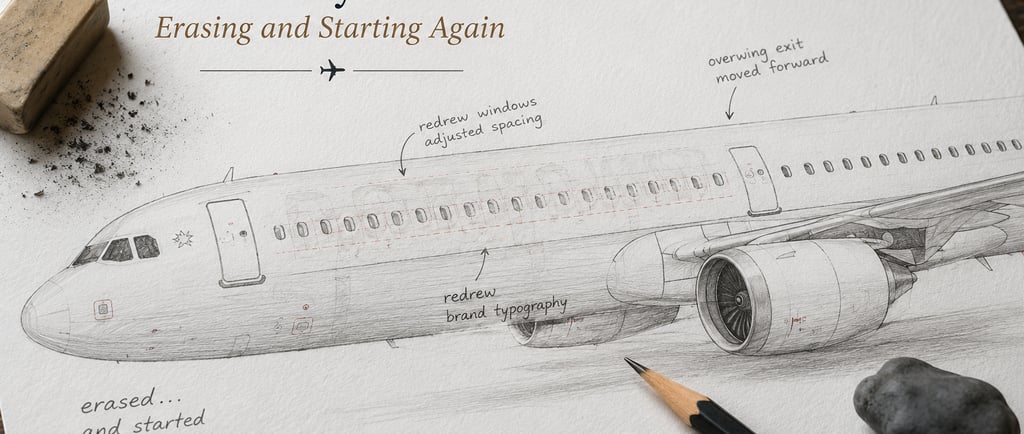
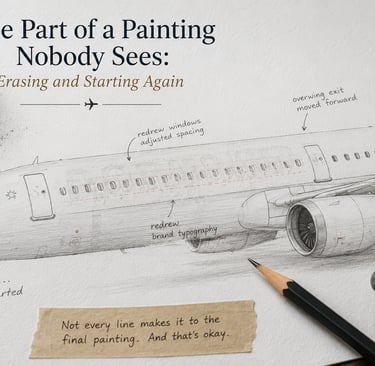
When we look at a finished painting, we usually see only the final result. We see the colours, the composition, the details and perhaps the story behind the subject. What we do not see are the lines that were erased, the sections that were redrawn, or the moments when the artist sat back and thought, “Something does not feel right.”
That invisible part of the process can sometimes take just as much time as the painting itself.
I was reminded of this recently while working on a detailed commission painting of an Airbus A321neo. Aircraft are unforgiving subjects. A slight change in the curve of the nose, the shape of an engine or the spacing between windows can alter the character of the entire aircraft. Even when a drawing is based on carefully measured grids, something can still feel slightly off.
At one stage, I had drawn the row of passenger windows and worked on the large brand typography along the fuselage. I had calculated the spacing carefully, but as I progressed towards the wing, I noticed that the overwing exit was not sitting where it should. The drawing looked convincing at first glance, yet the alignment bothered me.
So I erased the windows and the lettering and started again. It was frustrating, of course. Nobody enjoys removing work that has taken hours. But after studying additional reference photographs, I noticed that the spacing between the windows needed to be slightly wider and the lettering itself had subtle differences in proportion. Once I redrew them, the typography aligned much more accurately with the aircraft’s structure and the position of the wing root.
The same thing happened with other parts of the aircraft. Sometimes the grid points were correct, yet the curve connecting them did not quite capture the shape I was seeing in the reference. That is one of the interesting things about drawing: measurement can guide the hand, but the eye still has a role to play.
This experience is not limited to aviation art. Whether someone is painting a portrait, a landscape, a building or a simple still life, there are moments when a section technically appears correct but somehow does not feel convincing. The temptation is either to ignore it or to keep correcting it endlessly.
Neither is always the answer. I have learnt that there is a difference between making a meaningful correction and chasing perfection. If a change improves the structure, proportion or overall feeling of the painting, starting again can be worthwhile. But if the subject already reads correctly and the difference is something only visible under intense scrutiny, sometimes it is better to move forward.
Erasing, therefore, is not necessarily a sign that a drawing has failed. It can simply mean that the artist has looked more carefully.
The finished A321neo painting will never show how many measurements were checked, how many reference photographs were enlarged, or how often a line was reconsidered. A viewer may simply see an aircraft, a pilot and a completed composition.
And perhaps that is how it should be. Every finished artwork carries an invisible history beneath its surface: hesitation, correction, patience and persistence. The erased lines may disappear from the paper, but they remain part of the painting’s journey.
© 2025. Pramod's Art Studio All rights reserved. Registered MSME – Udyam No: UDYAM-TS-20-0133833